

Friday, December 23, 2011

Wednesday, December 21, 2011
Keeping Your Dog Active During the Holidays
The holidays are a crazy (but fun) time for everybody. With the cold weather, family dinners, and guests coming over, the dog can often get neglected. Here are a few quick ways that you can keep your dog mentally active everyday:


- Practice down stays while baking cookies. Build up your dog's down-stay so that he or she can eventually stay for the whole time the cookies are in the oven.

- Build a mini agility course in your house to show off your dog's awesome agility skills to guests. Jump over the broom propped on chairs, crawl under the piano bench, go around a chair, jump through a hula hoop and pause on the ottoman. Just make sure you have enough room for your dog to land on the jumps.
- Work on their contact spots by having them "go all the way" up or down the stairs. Remember that the skill you are focusing on is not leaping off before the last stair (Cheri was infamous for this). So, encourage them to go to the last stair, then reward them once they hit the last stair, just like you would when they hit the contact zone on the dog walk.
- Practice positive greetings with guests. Have your dog greet each guest by sitting. Once sitting, he or she gets attention from the guests. If the dog gets up, no more attention. This will quickly teach your dog that sitting gets attention. If your dog is shy, have guests offer tasty treats to help socialize him or her.
- Build those problem solving skills. Involve the kids and the dogs in hide and seek. Have one child hide with a tasty treat. Turn the dog loose and have the child call the dog's name. Once Fido finds the child, he gets a tasty treat. Repeat and increase difficulty as your dog becomes more proficient. Having guests over or taking your dog to a different place are great times to work on generalizing their obedience skills. Find a canine-savvy guest to give commands to your dog. Make sure the dog gets a reward every time they perform a task for a new person. Also, make sure the new "handler" knows all the right commands and that you are supervising. At a new place, go through a 2-3 minute obedience routine (sit, down, stay, etc.) in different rooms of the house. Doing these activities will help your dog learn that no matter the location or person, he or she still needs to perform the behavior when the command is given.
- Utilize the crate. Many people think crating is a punishment, but it is definitely not. Read this previous blog to see why crating is useful: A Dog's Crate is His Castle. Keeping your dog crate trained takes practice and there is no better time to work on crating skills than when the holidays are around. Don't feel guilty about putting Fido in there-he may even feel it's a sanctuary away from screaming kids, too many people, and the temptations of all those chocolate goodies and the Christmas tree water.
Monday, December 19, 2011
Christmas Bone
This happened a few years back, but for those of you who missed it or if you would just like to get another laugh, here it is!
Friday, December 16, 2011
Wednesday, December 14, 2011
Tunnel Sucker
I was looking through some agility sites and ran across this term and definition that I quite enjoyed.
Tunnel sucker: Any dog that preferentially goes to the tunnel over other obstacles regardless of the commands given by the handler.
Tunnel sucker: Any dog that preferentially goes to the tunnel over other obstacles regardless of the commands given by the handler.
From durangoagilitydogs.com
Monday, December 12, 2011
Breakaway Tires
USDAA has now implemented breakaway tires:
Why these are now being used in competitions:
What the break away tire looks like in action:
Why these are now being used in competitions:
What the break away tire looks like in action:
Friday, December 9, 2011
Visualization
In sports psychology, visualization is an important technique. Many athletes use visualization to help them perform better in competitions. Watch the video below to get a better of how a gymnast uses visualization to help her to learn her routine. (While it is more a documentary style, it's brief and you do get to listen to the British narrator!)
This type of visualization can also be applied to agility. Before a run or doing a complex sequence, it is a good idea to first think of the path your are going to take, the hand and body cues you are going to give, and the crosses you will use. You can then go over this path in your mind, slowly at first, without your dog. Does it seem to make sense? If not, you can make the adjustments in your brain before you make the mistakes on the course. Next, it's a good idea to then go through course/sequence again, this time putting your dog into the picture and adjusting as necessary. Last, but definitely not least, throw in the speed and distraction factors. As you work through the course each time in your brain, you should be able to problem solve and find the best way to direct your dog through the course. Like Rebecca in the video, you can then replay this mental film over and over so that your runs will be more successful.
Want to learn more? Check out this blog post by Susan Garrett Visualization; Can You See It?
This type of visualization can also be applied to agility. Before a run or doing a complex sequence, it is a good idea to first think of the path your are going to take, the hand and body cues you are going to give, and the crosses you will use. You can then go over this path in your mind, slowly at first, without your dog. Does it seem to make sense? If not, you can make the adjustments in your brain before you make the mistakes on the course. Next, it's a good idea to then go through course/sequence again, this time putting your dog into the picture and adjusting as necessary. Last, but definitely not least, throw in the speed and distraction factors. As you work through the course each time in your brain, you should be able to problem solve and find the best way to direct your dog through the course. Like Rebecca in the video, you can then replay this mental film over and over so that your runs will be more successful.
Want to learn more? Check out this blog post by Susan Garrett Visualization; Can You See It?
Wednesday, December 7, 2011
Canine Influenze
Winter is the time when everybody gets sick-including the dog!
 |
| http://www.moderndogmagazine.com/files/images/blogs/SickDog.jpg |
Canine Influenza can be serious and should be taken care of immediately. Below you will see some more information about it from the Center for Disease Control (http://www.cdc.gov/flu/canine/). Please just remember that if your dog is acting out of the ordinary or is showing any of the signs seen below, you should take him or her to the vet as soon as possible and keep your pooch home to limit the spread of the virus.
What is canine influenza (dog flu)?
Dog flu is a contagious respiratory disease in dogs caused by a specific Type A influenza virus referred to as a “canine influenza virus.” This is a disease of dogs, not of humans.
What is a canine influenza virus?
The “canine influenza virus” is an influenza A H3N8 influenza virus (not a human influenza virus) that was originally an equine (horse) influenza virus. This virus has spread to dogs and can now spread between dogs.
How long has canine influenza been around?
The H3N8 equine influenza virus has been known to exist in horses for more than 40 years. In 2004, however, cases of an unknown respiratory illness in dogs (initially greyhounds) were reported. An investigation showed that this respiratory illness was caused by the equine influenza A H3N8 virus. Scientists believe that this virus jumped species (from horses to dogs) and has now adapted to cause illness in dogs and spread efficiently among dogs. This is now considered a new dog-specific lineage of H3N8. In September of 2005, this virus was identified by experts as “a newly emerging pathogen in the dog population” in the United States.
What are the symptoms of this infection in dogs?
The symptoms of this illness in dogs are cough, runny nose and fever, however, a small proportion of dogs can develop severe disease.
How serious is this infection in dogs?
The number of dogs infected with this disease that die is very small. Some dogs have asymptomatic infections (no symptoms), while some have severe infections. Severe illness is characterized by the onset of pneumonia. Although this is a relatively new cause of disease in dogs and nearly all dogs are susceptible to infection, about 80 percent of dogs will have a mild form of disease.
How does dog flu spread?
Canine influenza virus can be spread by direct contact with aerosolized respiratory secretions from infected dogs, by contact with contaminated objects, and by people moving between infected and uninfected dogs. Therefore, dog owners whose dogs are coughing or showing other signs of respiratory disease should not participate in activities or bring their dogs to facilities where other dogs can be exposed to the virus. Clothing, equipment, surfaces, and hands should be cleaned and disinfected after exposure to dogs showing signs of respiratory disease.
Testing to confirm canine influenza virus infection is available at veterinary diagnostic centers. The tests can be performed using respiratory secretions collected at the time of disease onset or using two blood samples; the first collected while the animal is sick and the second 2 to 3 weeks later.
How is canine influenza treated?
Treatment largely consists of supportive care. This helps the dog mount an immune response. In the milder form of the disease, this care may include medication to make your dog more comfortable and fluids to ensure that your dog remains well-hydrated. Broad spectrum antibiotics may be prescribed by your veterinarian if a secondary bacterial infection is suspected.
Is there a vaccine for canine influenza?
Yes, an approved vaccine is available.
What is the risk to humans from this virus?
To date, there is no evidence of transmission of canine influenza virus from dogs to people and there has not been a single reported case of human infection with the canine influenza virus. While this virus infects dogs and spreads between dogs, there is no evidence that this virus infects humans.
However, human infections with new influenza viruses (against which the human population has little immunity) would be concerning if they occurred. Influenza viruses are constantly changing and it is possible for a virus to change so that it could infect humans and spread easily between humans. Such a virus could represent a pandemic influenza threat. For this reason, CDC and its partners are monitoring the H3N8 influenza virus (as well as other animal influenza viruses) along with instances of possible human exposure to these viruses very closely. In general, however, canine influenza viruses are considered to pose a low threat to humans. As mentioned earlier, while these viruses are well established in horse and dog populations, there is no evidence of infection among humans with this virus.
My dog has a cough what should I do?
Schedule an appointment with your veterinarian so that they can evaluate your dog and recommend an appropriate course of treatment.
Where can I find more information on canine influenza virus?
More information on canine influenza in pet dogs can be found in this article: Influenza A Virus (H3N8) in Dogs with Respiratory Disease, Florida in Emerging Infectious Diseases journal.
Monday, December 5, 2011
Google Dog Commercial
I can't tell a lie-I love this commercial :) If you haven't seen it on TV, go ahead and check it out here:
Friday, December 2, 2011
Flow and Momentum
This agility team has excellent flow. Watch for how the handler and dog work together fluidly. What kinds of techniques do you see being used?
Wednesday, November 30, 2011
Monday, November 28, 2011
Three Phases of Learning the Weaves
The weave poles are one of the most unnatural obstacles in agility. Because of this, it is one of the obstacles that takes the longest for dogs to learn. While the dogs are learning, there are many learning phases associated with the process. However, the phases can be broken down into three main categories, all revolving around where the dog is looking while weaving back and forth.
Phase 1: The initial phases of teaching the weaves include luring the dogs through, making sure they don't get off track, and praising them for correct placement. Dogs who are in this initial phase of learning will often either a) be looking anywhere but the poles (very beginning) and/or b) look up at their handler and his or her hands to see where they should go. This phase can last several weeks and even months, depending on how much time you practice with your dog and how consistent you are. During this part, I will often hear handlers say, "He's just following the treat," or "She isn't even paying attention."
Phase 2: This phase comes after A LOT of practice. During this time, the dog begins to become semi-independent on the weave poles. There are several indicators that your dog is in learning the correct weaving motion: moving the head around the poles, developing a rhythm, staying closer to the uprights, and watching the paws. However, the dog will still need occasional directions and corrections as he/she gets distracted, is confused, or loses mental focus. Again, depending on commitment and consistency on your part, this phase can last several weeks or several months. Handlers will often feel frustrated because their dog did it "perfectly" twice before, but makes a mistake the next time.
Phase 3: This final phase is not perfection, but like any other command, the dogs accurately performs the weaves at least 90% of the time on their own. Most dogs will move beyond looking at their paws and will instead be looking ahead, moving quickly, and having a constant stream of motion. This phase also includes working on any fine tuning, such as weave entrances, speed, motivation, and exits. Because dogs are (thankfully) not machines, the final portion of this stage is ongoing, but requires minimal handling but lots of practice tailored to your dog's specific needs.
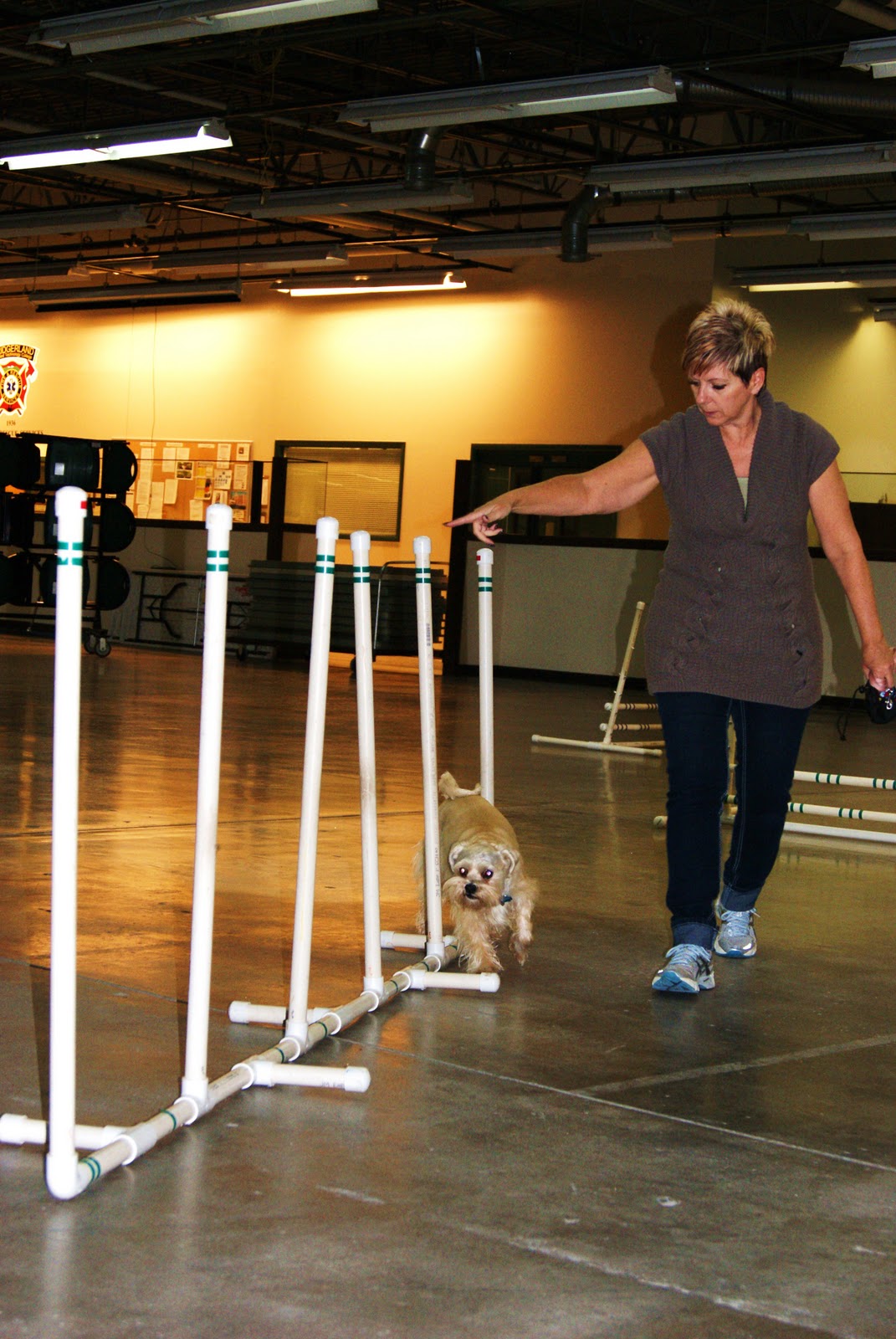
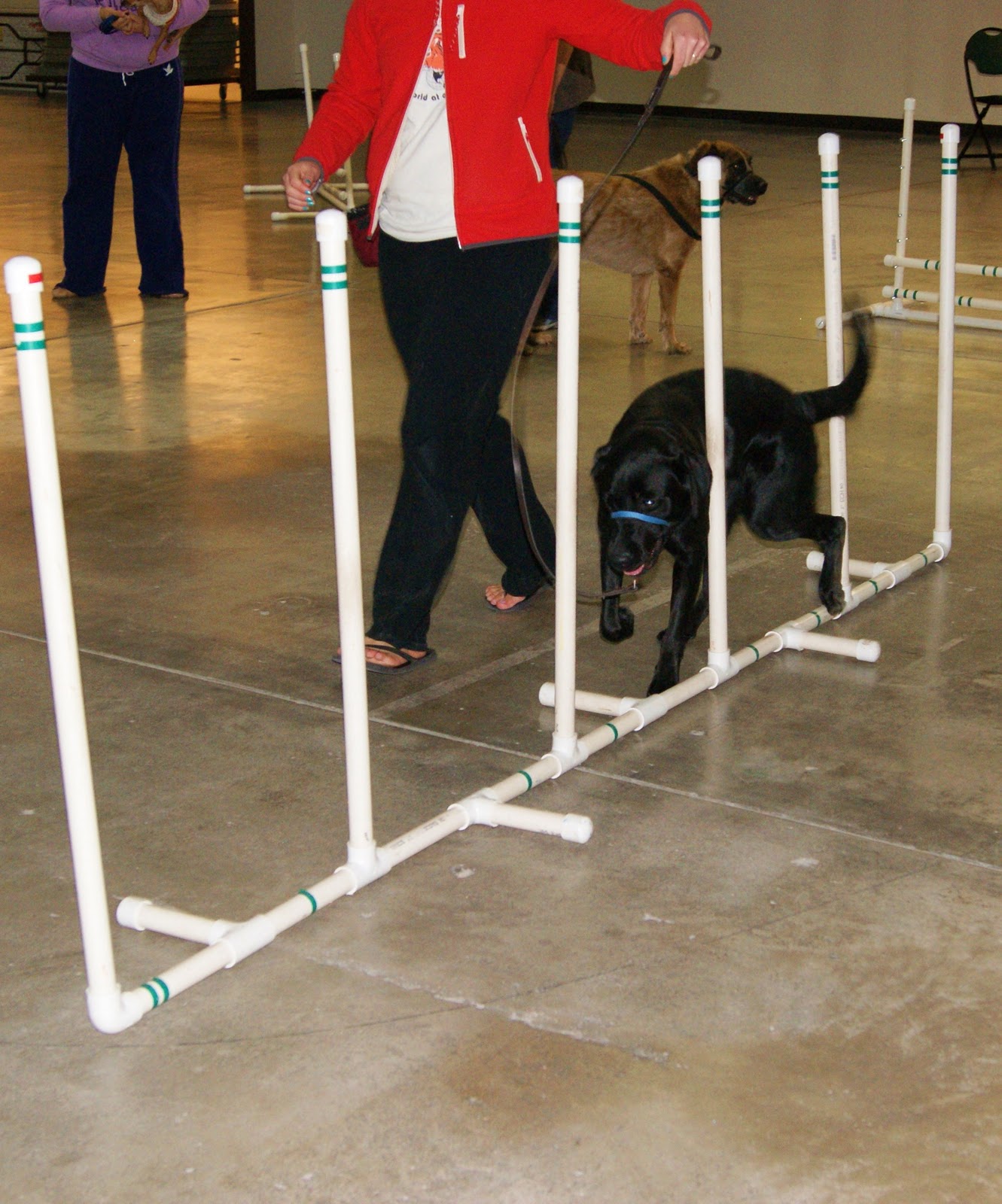
Below are several pictures of dogs who are in the second phase. As you can, each of them is watching their paws. The handlers are in various states of "weaning" themselves off so the dog becomes less and less dependent on them.
Lisa is still using her hand to lure Howser through the poles, but you can also tell that he is beginning to watch the poles while he is going around.
Dosha is getting a slight hand signal for formality's sake, though she is not looking at Cyndee's hand at all.
Cheri is also doing the weave poles relatively independently. While she can do them off-leash, her leash is on for other management issues not relating to weaving.
Last, we have Bailey, who appears to be doing the weaves all on her own. Beyond the scope of the picture, Lee is actually giving verbal motivation and is ready to jump in and assist Bailey as necessary.
Phase 1: The initial phases of teaching the weaves include luring the dogs through, making sure they don't get off track, and praising them for correct placement. Dogs who are in this initial phase of learning will often either a) be looking anywhere but the poles (very beginning) and/or b) look up at their handler and his or her hands to see where they should go. This phase can last several weeks and even months, depending on how much time you practice with your dog and how consistent you are. During this part, I will often hear handlers say, "He's just following the treat," or "She isn't even paying attention."
Phase 2: This phase comes after A LOT of practice. During this time, the dog begins to become semi-independent on the weave poles. There are several indicators that your dog is in learning the correct weaving motion: moving the head around the poles, developing a rhythm, staying closer to the uprights, and watching the paws. However, the dog will still need occasional directions and corrections as he/she gets distracted, is confused, or loses mental focus. Again, depending on commitment and consistency on your part, this phase can last several weeks or several months. Handlers will often feel frustrated because their dog did it "perfectly" twice before, but makes a mistake the next time.
Phase 3: This final phase is not perfection, but like any other command, the dogs accurately performs the weaves at least 90% of the time on their own. Most dogs will move beyond looking at their paws and will instead be looking ahead, moving quickly, and having a constant stream of motion. This phase also includes working on any fine tuning, such as weave entrances, speed, motivation, and exits. Because dogs are (thankfully) not machines, the final portion of this stage is ongoing, but requires minimal handling but lots of practice tailored to your dog's specific needs.
Below are several pictures of dogs who are in the second phase. As you can, each of them is watching their paws. The handlers are in various states of "weaning" themselves off so the dog becomes less and less dependent on them.
 |
| Lisa and Howser |
 |
| Cyndee and Dosha |
 |
| Becca and Cheri |
 |
| Bailey |
Wednesday, November 23, 2011

Monday, November 21, 2011

Friday, November 18, 2011
Committee Members: Meet Bob

Bob has always loved dogs but hasn’t had one because of allergies, until he discovered a “hypoallergenic” breed in the Kerry Blue Terrier. Paddy joined Bob’s family in 2009 and they both became involved in the sport of agility in the fall of 2010. This looked like a good sport for both the dog and the handler. Both Bob and Paddy have had fun (as well as some frustrating moments) with this sport. Bob became involved with the Club in order to help create an organization that will keep dog agility going and growing in Cache Valley.
Monday, November 14, 2011
Committee Members: Meet Lisa

Lisa Peterson, Secretary Zoomdog Agility and Sports Club
Hi, my name is Lisa Peterson. I have a big fuzzy 2 1/2 year old named Howser. He was born June 2009, a 100% pure breed mutt, and will talk to you and let you know if he doesn't agree with you. My husband and I don’t agree on what his mother was and don’t know what breed the father was. He has the face and body of a German Shepard with the floppy ears of an Australian Shepard and is very expressive with his eyes – when he isn't trying to sit on you (it is a compliment…..really….). Howser loves being out in the country with us and even enjoys playing and/or being chased by/with the barn cats even if they won’t try and wrestle with him. His favorite thing is to just be with his pack – going for walks, playing or just hanging out watching a movie.I work in a medical billing office, teach piano lessons and take Howser to Agility. I am a workaholic by nature and so having too much free time is hard for me. I have my Interdisciplinary Study degree through USU in Horticulture and French. I love to create and “play” in the dirt. Howser even helps me when I’m gardening but we still need to work on his keeping the dirt in the flower bed when he “helps” me dig holes.
Howser and I have been doing Agility since November of 2010 and have loved it since the beginning. I love being part of the Zoomdog Agility and Sports Club, as it gives both Howser and I a place to let him work and learn, and a place for me learn and meet new friends (fuzzy and non-fuzzy). Since Howser and I are pretty laid back we love that there is the Agility for Fun classes that we can take and continue the fun that we have doing Agility.
Committee Members: Meet Jacqueline

Jacqueline Guymon, Equipment Coordinator Zoomdog Agility and Sports Club
My name is Jacqueline Guymon and that little black and white bundle of energy is Panda Roo Ruggles Guymon. Yep, her name is longer than mine...and she runs a heck of a lot faster...BUT...I've got her beat when it comes to paying attention for any length of time. (That's not saying much; though, a squirrel could probably beat her too.)
Panda was born February 26, 2011 on a farm near Dayton, Idaho, where her mother (a red heeler) and her father (a border collie) are used for herding livestock. Panda would have liked to have finished her life on the farm--chasing livestock, eating unmentionables, and never having to wear a Gentle Leader--but alas, she was bought by a speech-pathologist, a child-nutrition manager, and a teenager. She has adapted well to our busy "city-folk" family: in the mornings, she dashes past me to jump into bed with Dad for snuggles, after school, she plays fetch (Chuck It and Zinger) with Jacob, in the evenings, she goes for long, brisk walks with me, and when nobody's looking, she find objects to turn into toys and food (which are the same to her). Her "trick resume" includes Sit Pretty, Bow, Spin, Get Your Tail, Back, and the all-time-favorite "Twitch!".
Panda was born February 26, 2011 on a farm near Dayton, Idaho, where her mother (a red heeler) and her father (a border collie) are used for herding livestock. Panda would have liked to have finished her life on the farm--chasing livestock, eating unmentionables, and never having to wear a Gentle Leader--but alas, she was bought by a speech-pathologist, a child-nutrition manager, and a teenager. She has adapted well to our busy "city-folk" family: in the mornings, she dashes past me to jump into bed with Dad for snuggles, after school, she plays fetch (Chuck It and Zinger) with Jacob, in the evenings, she goes for long, brisk walks with me, and when nobody's looking, she find objects to turn into toys and food (which are the same to her). Her "trick resume" includes Sit Pretty, Bow, Spin, Get Your Tail, Back, and the all-time-favorite "Twitch!".
In contrast, I am pretty boring. By day, I work in an elementary school helping kids learn how to say their sounds correctly, improve their language, and speak fluently. Fifteen months ago, I would have liked nothing more than to spend my nights reading long novels, scrapbooking, or playing games with my family. I found a new favorite in August 2010--running around jumps, tunnels, chutes, and other obstacles with a dog. Sadly, the dog I had back then (Ollie) passed away in March 2011.
I'm grateful that Zoomdog Agility and Sports Club had been formed. It has given me a place to train Panda, great people (and dogs) to hang out with, and of course, Becca: the source of knowledge for all-things-dog. My plan is to complete all of the beginning and intermediate dog agility classes that Zoomdog offers and then taking the Dog Agility For Competition class and start competing with Panda. Well, that's enough about us. I hope to meet you in class or at a Zoomdog social!
Friday, November 11, 2011
Committee Members: Meet Lee
Zoomdog Agility and Sports Club is run by a very dedicated and dog-loving volunteer committee. Today we will let Lee introduce herself. Make sure you watch for other committee member bios to be posted on the blog during the following weeks!

Lee Tansock, Vice President Zoomdog Agility and Sport Club
I have two shelties and enjoy watching dogs learn, discover, and become well behaved. We became involved with agility after my puppy certified as AKC Canine Good Citizen. We were looking for ways to continue to challenge her and keep her focused and working and agility turned out to be a great way to accomplish these goals. We also discovered agility to be challenging for both handler and dog and quickly discovered that it was immensely fun at the same time. Agility training has provided me with the ability, through voice commands, body language, and hand signals, to handle a now confident dog through easy or complicated courses and have fun while doing so. My dog LOVES it too.
Wednesday, November 9, 2011
Pet Place
Here is a fun website to check out when you have a little free time: PetPlace.com

And if you're like me and love videos, you can find a ton of their dog clips here: Pet Place Videos
Here is one of my favorites (make sure you check out the colored Poodle ears!): Dogs Jumping Rope
Monday, November 7, 2011
Perfecting Contact Spots

There are a lot of ways to teach contact spots. However, these are not the focus of this post. Instead, I want to share this picture of Keahi. Not only is she modeling a terrific winter sweater, she is also exhibiting good form on the walk. Her front two paws have already touched the contact zone, and from looking at her, her handler should be able to tell that she is headed in the right direction to cleanly exit this obstacle. Here are the two major signs:
- She is lined up parallel with the sides of the dog walk.
- Her head is focused on the goal-she is looking ahead at where she needs to go.
At this point, her handler should be giving her a positive marker for doing exactly what she needs to be doing! Thanks Ahi for being a great example!
Now, in opposition to the good signs, what are the signs that your dog is about to jump off before properly exiting the obstacle? First, let me just note that my definition of properly exiting the obstacle is that the dog goes all the way down the ramp without jumping off the side (regardless of how many paws touch the contact spot or not).
- The dog is at an angle to to the sides of the ramp-if he or she kept following that projected path, they would jump off too early.
- The dog is looking off to the side-dogs usually think about what their eyes are seeing. So, if they are looking off to the side, they most likely are not thinking about going all the way down the walk.
At this point, the handler should jump in there and help the dog exit the dog walk properly by luring the dog, encouraging him or her to go all the way down, and praising when the dog behaves appropriately. This way, the dog does not learn the bad behavior of doing an improper exit, is rewarded for doing it correctly, and thus is more likely to do it the right way next time.
Subscribe to:
Posts (Atom)